
Explainer
How We Temperament Test Puppies at 6–7 Weeks
By Jordan · Reviewed by Jordan
Published October 5, 2026 · 3 min read
Quick answer
At around six to seven weeks, each puppy goes through a structured evaluation in a neutral setting: coming when called, following, tolerating gentle restraint, recovering from a startle, solving a small problem, and reacting to touch and new textures. It is a guide rather than a verdict — combined with weeks of daily observation, it tells us which household each puppy is likely to thrive in.
Families are often surprised that they cannot pick their puppy from photos at three weeks. The reason is simple: the puppy in that photo does not exist yet. Puppies change dramatically between birth and seven weeks, and the clearest picture of who they are arrives right at the end of their time with us.
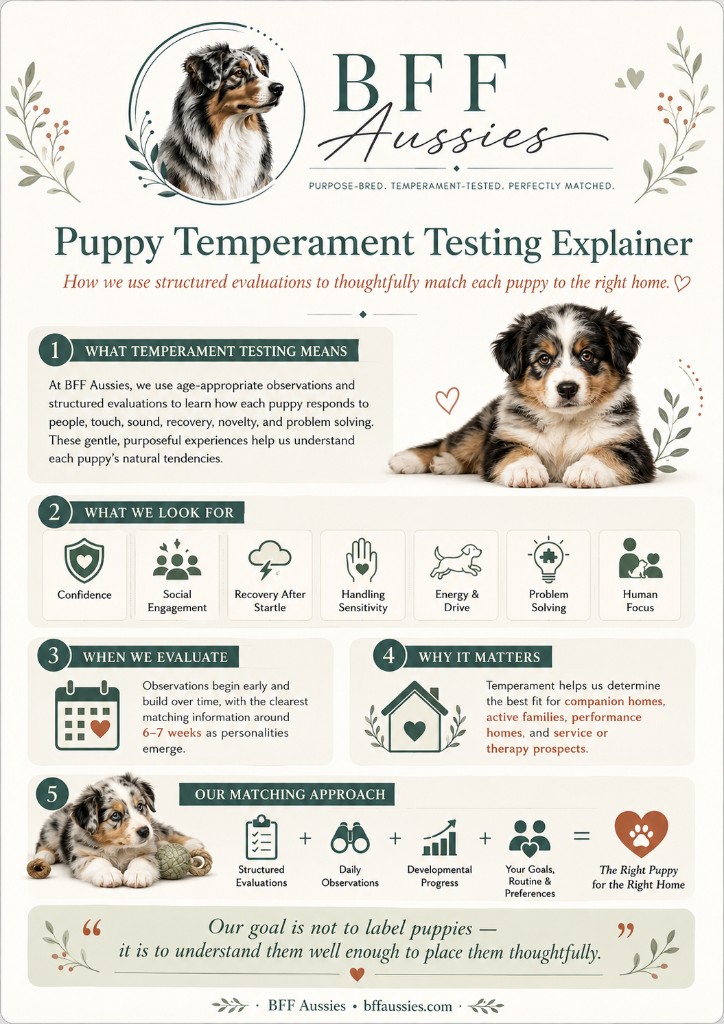
The short version. The full process is described below.
What temperament testing means
We use age-appropriate observations and structured evaluations to learn how each puppy responds to people, touch, sound, recovery, novelty and problem solving. These are gentle, purposeful experiences that show us each puppy's natural tendencies.
Most of our testing is based on the Volhard Puppy Aptitude Test, together with additional observations we have refined over many litters of Australian Shepherds.
Why we test
Early temperament testing gives us an objective look at who each puppy is becoming.
We spend every day with these puppies and learn a great deal from daily handling, play and social interaction. But a structured test lets us see how each puppy responds in a neutral environment with standardized challenges — the same tasks, the same order, the same handler. That is what makes placement decisions thoughtful, ethical and in the best interest of both the puppy and the family.
What we evaluate
Task
What it tells us
Social attraction and confidence
Does the puppy come when called? Do they hesitate or confidently engage?
Following and engagement
Are they people-oriented? Do they enjoy being with a handler?
Restraint tolerance
How do they respond to gentle restraint — calm, wiggly, or stressed?
Sound and startle recovery
How quickly do they bounce back from a new or unexpected noise?
Object and problem solving
Interest in toys, retrieving ability, curiosity, willingness to explore
Touch, sight and sensitivity
Reaction to new textures, and gentle testing of sensitivity levels
Energy level and drive
Which puppies want a more active home, and which prefer a calmer lifestyle
When we evaluate
Observations begin early and build over time, with the clearest matching information arriving around 6–7 weeks, as personalities emerge.
How we do it at BFF Aussies
Testing is one input, not the only one. It sits alongside weeks of daily observation, the puppy's developmental progress, and everything you have told us about your household, routine and goals.
How this helps match puppies to homes
Our goal is always to place each puppy in the environment where they will thrive, not just fit. Testing helps us match:
- •Active families with puppies who have the confidence, drive and curiosity to enjoy hikes, sport and busy lifestyles
- •Laid-back families with puppies who prefer a calmer, cuddlier, more easygoing temperament
- •Experienced homes with the pups who show high intelligence, strong working instincts or very forward personalities
- •First-time owners with puppies who are naturally more adaptable and people-pleasing
Testing acts as a guide, not the sole deciding factor, but it gives us extremely helpful insight when placing our puppies.
Identifying service and therapy candidates
Temperament testing matters especially for identifying the rare puppies suited to service dog training, therapy visits or emotional support roles. We look for:
- •High tolerance to stress
- •Quick recovery from startle
- •Willingness to follow and engage
- •Calm, thoughtful decision-making
- •Lower reactivity
- •Strong human connection
- •Balanced energy — not overly timid, not overly dominant
Not all puppies fall into this category, nor should they. The ones who do often shine during this stage of testing.
Why we wait to assign puppies until testing is complete
We do not allow families to choose a puppy before temperament testing, for three reasons:
- 1Appearance alone cannot predict temperament, health or lifestyle suitability.
- 2Matching personalities to families produces better long-term outcomes, especially for households with children, first-time owners, or particular needs.
- 3Puppies change dramatically between birth and seven weeks — testing gives the clearest picture before placement.
We always take your preferences into account. Our responsibility as their breeder is to make the best possible match for everyone involved.
Note
Our goal is not to label puppies — it is to understand them well enough to place them thoughtfully.
Key takeaways
Testing happens at 6–7 weeks, when personalities are clear enough to read.
Tasks are standardized so puppies are compared on the same challenges in a neutral setting.
Results guide placement — they are never the only input, and daily observation matters as much.
Puppies are not assigned before testing, because appearance cannot predict temperament.
Puppy Temperament Testing Explainer (printable)
The one-page summary. Our full written process is linked in the article.
Download
Common questions
What is the Volhard Puppy Aptitude Test?
A long-established set of standardized tasks — social attraction, following, restraint, social dominance, elevation, retrieving, touch and sound sensitivity — scored to describe a puppy's tendencies. Most of our testing is based on it, alongside observations we have refined over many litters of Australian Shepherds.
Can a temperament test predict exactly how my dog will turn out?
No. It is a snapshot of tendencies at seven weeks, and how a dog is raised matters enormously afterwards. It is a guide that makes placement far better than guessing — not a guarantee.
Why can't I choose my puppy before the test?
Because appearance cannot predict temperament, health or lifestyle suitability, and puppies change dramatically between birth and seven weeks. Testing gives the clearest picture right before placement.
How do you identify service or therapy prospects?
We look for high stress tolerance, quick recovery from a startle, willingness to follow and engage, calm decision-making, lower reactivity, strong human connection and balanced energy. Few puppies fit that profile — and they should not all have to.
Matching starts with knowing your household — the questionnaire is how we learn it.
Start the questionnaire
Keep reading
Part of Puppy Development & Our Curriculum