
Explainer
Puppy Socialization vs. Overexposure
By Jordan · Reviewed by Jordan
Published October 5, 2026 · 4 min read
Quick answer
Socialization is letting a puppy meet the world at their own pace, in short sessions that end while they are still comfortable. Overexposure is the same world delivered too fast, too loud, or for too long — and it builds fear rather than confidence. The difference is not how many places a puppy visits; it is whether the puppy stays relaxed, gets to choose, and recovers quickly afterwards.
Every family who joins our waitlist asks some version of the same question: how much should I be doing with my puppy? The honest answer is that the number of outings matters far less than how each one goes. A puppy who watches a skateboard roll past from twenty feet away, eats a treat and trots on has learned that the world is manageable. A puppy who is carried into the middle of a farmers market has learned that it is not.
What socialization actually means
Socialization is not exposure for its own sake. It is the work of teaching a puppy that new things are safe, predictable and worth investigating — while they are still young enough to form those impressions easily.
The distinction that matters is choice. When a puppy can approach at their own speed, pause, retreat and come back, they are learning. When they cannot leave, they are only coping.
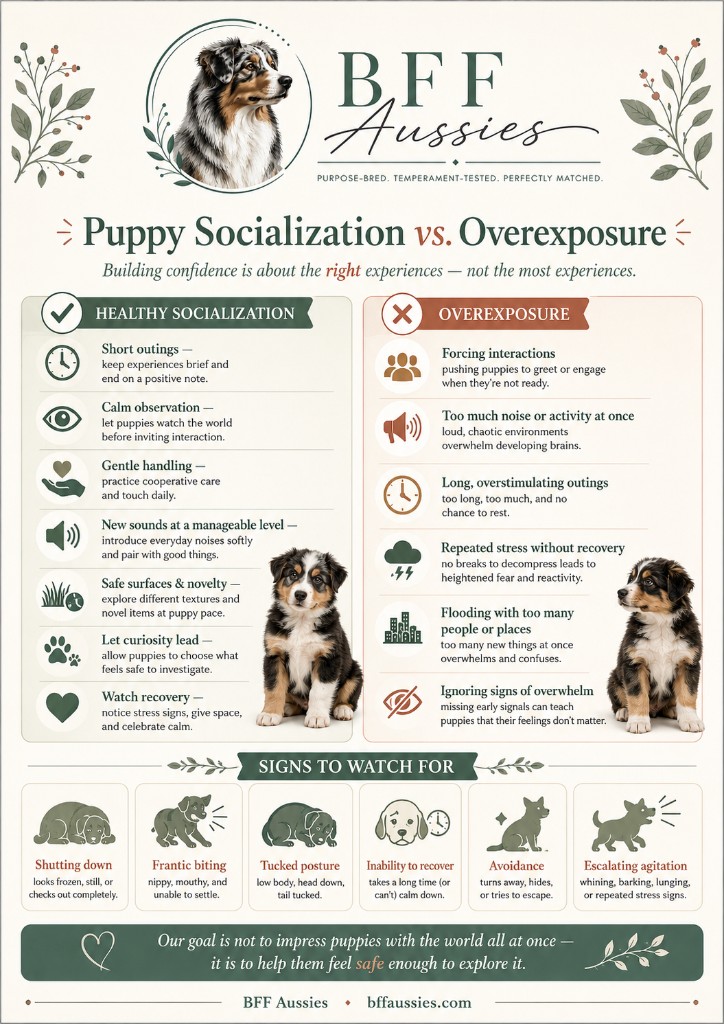
Our one-page guide — the full text is below so you can read it on any device.
What healthy socialization looks like
- •Short outings — keep experiences brief and end on a positive note.
- •Calm observation — let puppies watch the world before inviting interaction.
- •Gentle handling — practice cooperative care and touch daily.
- •New sounds at a manageable level — introduce everyday noises softly and pair them with good things.
- •Safe surfaces and novelty — explore different textures and novel items at puppy pace.
- •Let curiosity lead — allow puppies to choose what feels safe to investigate.
- •Watch recovery — notice stress signs, give space, and celebrate calm.
Tip
End every outing while your puppy is still having a good time. The temptation is always to stay "just a bit longer" because things are going well — that is usually the moment things stop going well.
What overexposure looks like
The activities below are not bad in themselves. They become overexposure because of the dose: too much at once, too long, or without the puppy having any say.
- •Forcing interactions — pushing puppies to greet or engage when they are not ready.
- •Too much noise or activity at once — loud, chaotic environments overwhelm developing brains.
- •Long, overstimulating outings — too long, too much, and no chance to rest.
- •Repeated stress without recovery — no breaks to decompress leads to heightened fear and reactivity.
- •Flooding with too many people or places — too many new things at once overwhelms and confuses.
- •Ignoring signs of overwhelm — missing early signals teaches puppies that their feelings do not matter.
Signs to watch for
These are the six signals we teach our families to treat as a full stop. One of them means give the puppy space; two means the outing is over.
Signal
What it looks like
Shutting down
Looks frozen, still, or checks out completely
Frantic biting
Nippy, mouthy, and unable to settle
Tucked posture
Low body, head down, tail tucked
Inability to recover
Takes a long time — or cannot — calm down
Avoidance
Turns away, hides, or tries to escape
Escalating agitation
Whining, barking, lunging, or repeated stress signals
Safety
A puppy who stops taking food, stops sniffing or stops moving normally is not "being stubborn" — those are early stress signals. Increase distance, lower the volume, or leave.
How we do it at BFF Aussies
Socialization starts here, long before your puppy comes home — it is built into our program from the first weeks of life.
How we do it at BFF Aussies
Early Neurological Stimulation and Early Scent Introduction run from days 3 to 16, as brief daily exercises, and only when puppies are healthy, stable and thriving. From there the curriculum continues with daily gentle handling, new surfaces and sounds introduced at a manageable level, and everyday household life. Around 6–7 weeks each puppy is temperament tested and evaluated for the kind of home that fits them.
That means the puppy you collect has already met novelty in small, positive doses and has practice recovering from it. Your job in the first weeks at home is to continue at the same pace — not to make up for lost time. The puppy prep checklist covers what to have ready before that first week starts.
- 1Give the first few days at home to be boring: your house, your yard, your family. That is enough novelty.
- 2Add one new thing at a time, at a distance your puppy can handle, and let them approach it if they want to.
- 3Watch for the six signals. If you see one, add distance; if you see two, go home.
- 4Finish while they are still relaxed, then allow a real rest — young puppies sleep most of the day, and that rest is part of the work.
The rule we come back to
Our goal is not to impress puppies with the world all at once. It is to help them feel safe enough to explore it.
If you are ever unsure whether to push on or call it a day, call it a day. You can always repeat a calm, successful outing. Undoing a frightening one takes much longer.
Key takeaways
Short outings that end on a good note beat long ones every time.
Let the puppy choose to approach — never carry or push them into a greeting.
Watch recovery: a confident puppy shakes it off quickly, an overwhelmed one stays switched on.
Six signals mean stop: shutting down, frantic biting, tucked posture, no recovery, avoidance, escalating agitation.
Puppy Socialization vs. Overexposure (printable)
The one-page version we give our families — print it for the fridge.
Download
Common questions
How many new places should a puppy visit each week?
There is no magic number. A handful of short, calm outings a puppy recovers from easily is worth more than a packed schedule they endure. If your puppy is slow to settle afterwards, do less next time, not more.
My puppy froze at a busy park. Did I ruin them?
No. One overwhelming outing is not permanent, but it is information. Give them a quiet day or two, then rebuild with calmer versions of the same thing — watching from a distance where they can still eat, play and move freely.
Should I let strangers hold my puppy?
Only if the puppy chooses to approach and stays loose and wiggly. Passing a puppy around a group is a common way for a confident puppy to learn that people take away their choices.
Sources
•
Position Statement on Puppy Socialization — American Veterinary Society of Animal Behavior (AVSAB)
•
AVSAB position statements — American Veterinary Society of Animal Behavior (AVSAB)
This page describes how we raise puppies at BFF Aussies and general socialization principles. It is not veterinary or behavioral advice for your individual dog. If your puppy shows persistent fear, panic or aggression, talk to your veterinarian or a qualified behavior professional.
Socialization at BFF Aussies starts long before go-home day.
See how we raise our puppies
Keep reading
Part of Puppy Development & Our Curriculum