
Guide
Puppy Development Week by Week: Birth to Go-Home Day
By Jordan · Reviewed by Jordan
Published October 5, 2026 · 3 min read
Quick answer
In the first eight weeks a puppy goes from a sleeping newborn who cannot regulate their own temperature to a small dog who has met crates, car rides, grooming tools, household noise and visitors. The work is cumulative and age-appropriate: brief handling in the first days, structured handling and novelty from week three, then real-world exposure and go-home preparation in weeks six to eight.
People often assume a breeder's job during the first eight weeks is mostly feeding and cleaning. The feeding and cleaning are real, but the part that shapes the dog you get is quieter: what a puppy is asked to cope with each week, and whether they are ready for it.
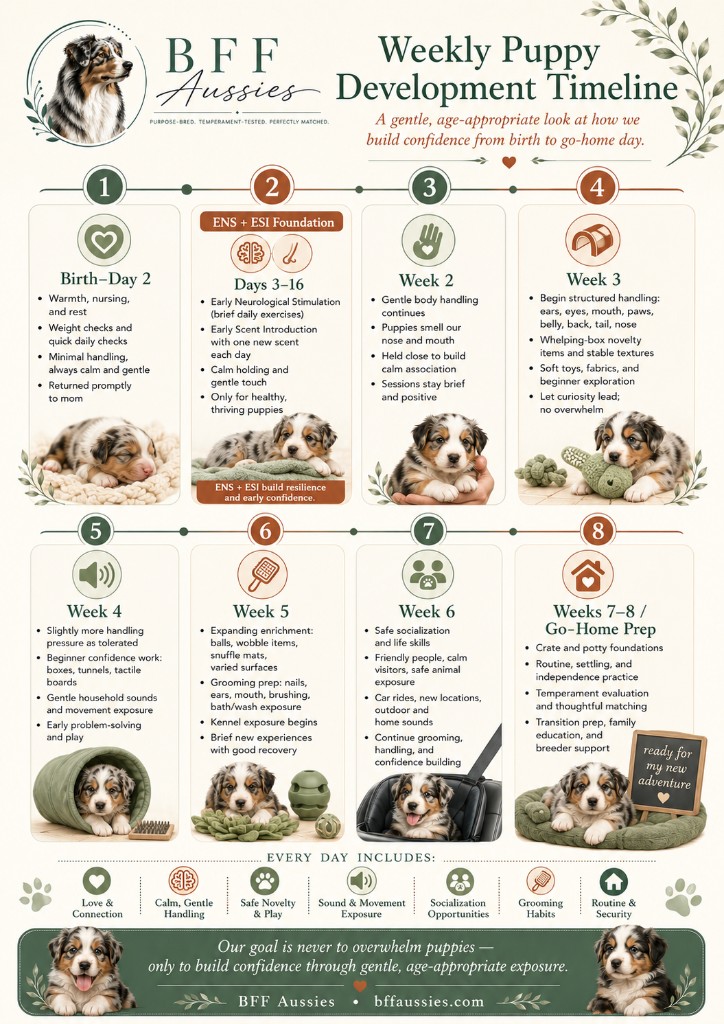
The full timeline. Each stage is described below.
Birth to day 2
Nothing is asked of them yet.
- •Warmth, nursing and rest
- •Weight checks and quick daily checks
- •Minimal handling, always calm and gentle
- •Returned promptly to mom
Days 3–16: the ENS and ESI window
This is the only window for Early Neurological Stimulation, so it is the one part of the calendar that cannot move.
- •Early Neurological Stimulation: brief daily exercises
- •Early Scent Introduction: one new scent each day
- •Calm holding and gentle touch
- •Only for healthy, thriving puppies
How we do it at BFF Aussies
ENS and ESI are performed carefully, briefly, and only when puppies are healthy, stable and thriving. They never replace warmth, nursing, rest or normal bonding with their mother. ENS and ESI build resilience and early confidence — they are one part of a curriculum, not the whole of it.
Week 2
Eyes and ears are opening, so the world starts arriving on its own.
- •Gentle body handling continues
- •Puppies smell our nose and mouth
- •Held close to build calm association
- •Sessions stay brief and positive
Week 3
The socialization period begins, and structured work starts.
- •Structured handling: ears, eyes, mouth, paws, belly, back, tail, nose
- •Whelping-box novelty items and stable textures
- •Soft toys, fabrics and beginner exploration
- •Let curiosity lead; no overwhelm
Week 4
- •Slightly more handling pressure, as tolerated
- •Beginner confidence work: boxes, tunnels, tactile beds
- •Gentle household sounds and movement exposure
- •Early problem-solving and play
Week 5
Grooming preparation starts here, long before it is needed.
- •Expanding enrichment: balls, wobble items, snuffle mats, varied surfaces
- •Grooming prep: nails, ears, mouth, brushing, bath and wash exposure
- •Kennel exposure begins
- •Brief new experiences with good recovery
Tip
If you are choosing a breeder, ask when grooming and crate exposure start. A puppy who first meets nail clippers at twelve weeks has a much harder time than one who met them at five.
Week 6
- •Safe socialization and life skills
- •Friendly people, calm visitors, safe animal exposure
- •Car rides, new locations, outdoor and home sounds
- •Continued grooming, handling and confidence building
Weeks 7–8: go-home preparation
- •Crate and potty foundations
- •Routine, settling and independence practice
- •
- •Transition preparation, family education and breeder support
Every day includes
Whatever week it is, the same seven things happen:
- •Love and connection
- •Calm, gentle handling
- •Safe novelty and play
- •Sound and movement exposure
- •Socialization opportunities
- •Grooming habits
- •Routine and security
Safety
Rest is part of the curriculum, not a gap in it. Young puppies sleep most of the day, and a puppy who is being handled or stimulated instead of sleeping is not getting more out of the week — they are getting less.
What this means for your first weeks at home
Your puppy arrives with a foundation, not a finished education. The socialization period continues past go-home day, and the AVSAB's position is that early, careful socialization matters enough that it should not wait for a full vaccination series — done safely, in controlled settings, in consultation with your veterinarian.
Practically, that means continuing at the pace we set rather than starting over or racing to catch up:
- 1Keep the first days quiet and predictable — your home is already a lot of novelty.
- 2Add one new thing at a time, and let your puppy choose whether to approach.
- 3Keep grooming and crate practice going; they are habits, not events.
- 4Protect sleep as carefully as you protect exposure. Our puppy prep checklist covers the practical side of that first week.
Our goal is never to overwhelm puppies — only to build confidence through gentle, age-appropriate exposure.
Key takeaways
Weeks 3–8 are when a puppy learns whether new things are safe — the work cannot be made up later.
Handling starts brief and gentle, and increases only as the puppy tolerates it.
Grooming, crate and car exposure all begin before go-home day, not after.
Every day includes rest, not just stimulation.
Weekly Puppy Development Timeline (printable)
The full timeline on one page.
Download
Common questions
Why do puppies go home at eight weeks?
By eight weeks a puppy has had the early socialization work that only the litter and the breeder can provide, and is developmentally ready to bond with a new family. Going earlier costs them important learning from their mother and littermates.
What should I ask a breeder about the first eight weeks?
Ask what handling the puppies get each week, what sounds and surfaces they have met, whether crates and car rides have been introduced, and how the breeder decides which puppy goes where. Vague answers are an answer.
Is my puppy fully socialized when they come home?
No — they have a foundation. The socialization window continues past go-home day, which is why the first weeks at home matter so much. Continue at the same gentle pace rather than rushing to catch up.
Sources
•
Position Statement on Puppy Socialization — American Veterinary Society of Animal Behavior (AVSAB)
This describes our program and general puppy development. It is not veterinary advice. Vaccination timing, health checks and any concerns about a specific puppy belong with your veterinarian.
This timeline is part of our Puppy Preparation & Placement Plan.
See our program
Keep reading
Part of Puppy Development & Our Curriculum